
Hudson County Court Records After Arrest
Hudson County has three records lanes after a jail arrest. The Hudson County Adult Correctional Center can confirm current custody through the Department of Corrections and Rehabilitation phone route. New Jersey Courts maintains criminal case records, charge status, judgments, and municipal complaint data. The Hudson County Prosecutor's Office handles serious criminal prosecutions, while municipal courts handle lower-level complaints, traffic matters, and summons-related cases.
A jail booking is not the same record as a court case. Booking shows that a person entered county custody or was processed on a charge. Court records after a jail arrest show what was filed, amended, dismissed, diverted, or proved. For the custody side, use Hudson County jail inmate records. For booking-photo issues, use Hudson County jail mugshots. The court record controls the legal path after the arrest, especially when a complaint becomes an accusation, indictment, diversion, plea, trial, or judgment.
Key point: Hudson County jail staff may confirm custody, but court systems are the source for charge status, judgments, and hearing records.
Find Hudson County Court Records After Arrest
Start with the official New Jersey Courts tools. The Find a Case page routes users to case jackets, criminal cases, criminal judgments, municipal court cases, and record-request options. For indictable state criminal cases, use PROMIS/Gavel Public Access. For final judgments, use Criminal Judgments Public Access. For municipal complaints and traffic matters, use Municipal Court Case Search.
- Confirm present custody through Hudson County Corrections if the immediate question is where the person is held.
- Decide whether the matter is municipal, indictable Superior Court, or federal. The wrong system can return no result.
- Search PROMIS/Gavel by name, CDR number, indictment number, or accusation number when those identifiers are known.
- Open the matching case and read each count, status term, court event, and judgment entry before treating a charge as final.
New arrests may not appear at once. Some matters require courthouse access, clerk help, attorney records, or a formal records request. Federal criminal cases are separate from New Jersey Courts and should be checked through PACER or the U.S. District Court for the District of New Jersey.
| System | Best Use After a Hudson County Arrest |
|---|---|
| PROMIS/Gavel | Indictable criminal cases, CDR searches, indictment or accusation searches, and defendant-name searches. |
| Municipal Court Case Search | Municipal complaints, traffic matters, and lower-level cases tied to a municipal court. |
| Criminal Judgments Public Access | Judgments of conviction and other final criminal judgment records. |
| County jail phone lookup | Current Hudson County custody status, not the final court outcome. |
Hudson County Court Records Search Fields
PROMIS/Gavel is the main public criminal case access route identified in the research for Hudson County court records after a jail arrest. Its search menu supports different paths, so complete one search type at a time. A CDR number from complaint paperwork can be more precise than a common name. An indictment or accusation number can be useful after the case has moved beyond the first complaint stage.
| Field Label | Type | Required | Options / Format Notes |
|---|---|---|---|
| Last Name | text | required for name search | Use defendant last name. |
| First Name | text | likely required for name search | Use the legal first name when known. |
| M. | text | optional | Middle initial field. |
| Indictment/Accusation # | text | required for that path | Use if provided by court, attorney, or case paperwork. |
| CDR # | text | required for that path | Use the criminal complaint number from police or court paperwork. |
| Search type | implicit sections | yes | Complete one search type only. |
| Search button | button | n/a | Runs the selected search. |
The New Jersey Courts criminal judgment portal is also relevant when a case has ended. The Criminal Judgments Public Access page is shown in the source image below.
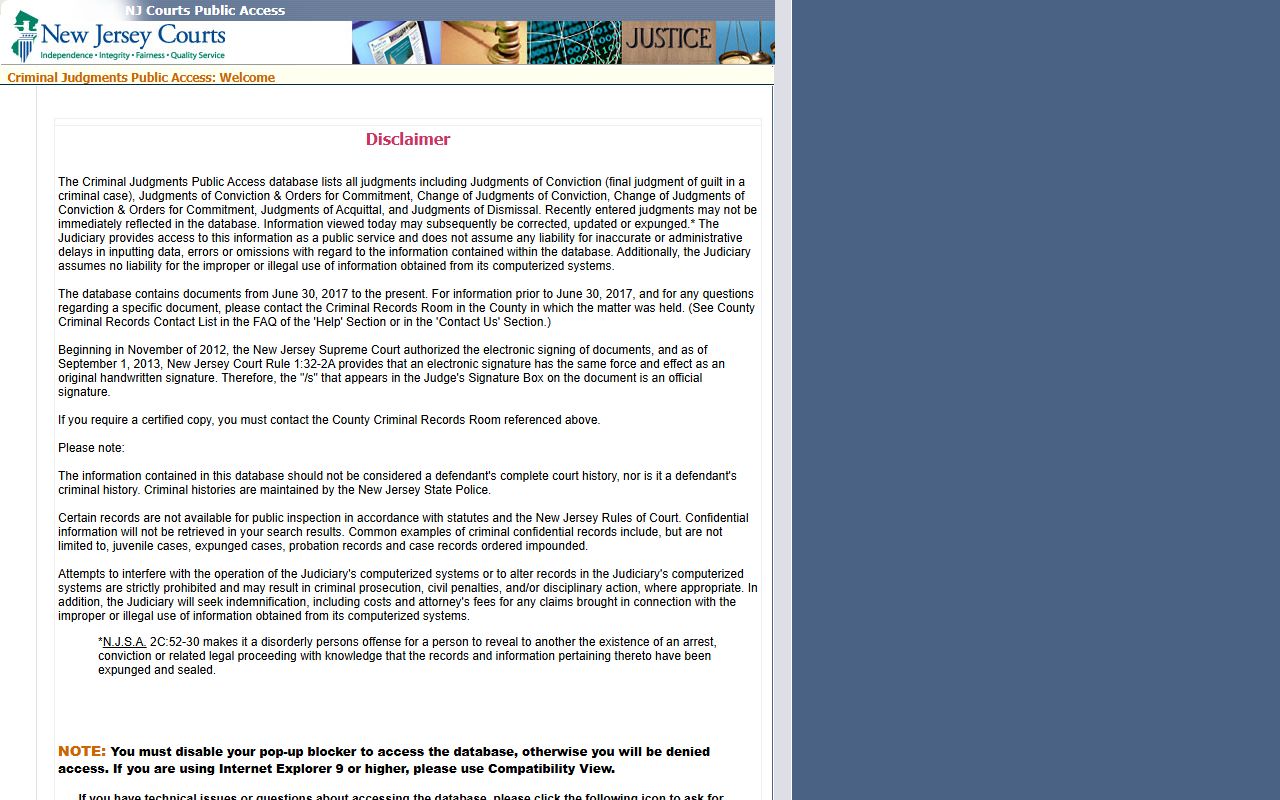
Use that judgment search after the case reaches a final court outcome, then compare it with PROMIS/Gavel when earlier charge history matters.
Hudson County Charging Records After Arrest
After a Hudson County jail arrest, the first charge terms may come from a complaint or CDR. That early record can later be changed by the prosecutor or grand jury process. New Jersey uses complaints, accusations, indictments, and judgments of conviction in different stages. The name of the document matters because it tells whether the matter is early, waived from indictment, formally indicted, or already resolved.
| Document | Who Uses It | What It Means | Search Clue |
|---|---|---|---|
| Complaint / CDR | Police, court, or prosecutor | Early charging record often tied to arrest, summons, or warrant process. | CDR number in PROMIS/Gavel or municipal search. |
| Accusation | Prosecutor | Formal charging document that may be used when indictment is waived. | Accusation number in PROMIS/Gavel. |
| Indictment | Grand jury | Formal Superior Court charge for indictable crimes. | Indictment number in PROMIS/Gavel. |
| Judgment of conviction | Court | Final judgment after guilt by plea or trial. | Criminal Judgments Public Access. |
The prosecutor's role is strongest in indictable cases. Municipal police may start the complaint, but the Hudson County Prosecutor's Office evaluates and prosecutes serious criminal matters. A booking charge can be replaced by a better framed count, a downgraded count, or an indictment that looks different from the first custody paperwork.
Hudson County Arrest Charge Status
Charge status is the part of Hudson County court records after arrest that most often changes. Pending does not mean proved. Dismissed does not always mean the whole case is gone if other counts remain. Diversion and conditional dispositions can keep a case open while conditions are met. Expunged means public disclosure is restricted by court order and New Jersey law.
| Status | What It Means | Reader Caution |
|---|---|---|
| Pending | The charge or case is still open. | Do not treat it as a conviction. |
| Amended | The filed charge changed from an earlier version. | Compare dates and count numbers. |
| Downgraded / reduced | A lesser charge replaced the prior charge. | The booking charge may look more serious than the final count. |
| Dismissed | That charge ended without conviction on that count. | Check whether other counts remain. |
| Diversion / PTI | Eligible case is handled through court-supervised conditions. | Completion terms and final status matter. |
| Convicted | Guilt entered by plea or trial and judgment imposed. | Use the judgment record for final outcome. |
| Expunged | Record is sealed or isolated by court order. | Wrongful disclosure can violate New Jersey law. |
Hudson County Arrest Release Records
New Jersey pretrial rules make release records more complex than a simple bond list. Under N.J.S.A. 2A:162-17, the court makes a pretrial release decision without unnecessary delay and no later than 48 hours after eligible commitment to jail. The decision can include recognizance release, conditions, monitoring, a monetary condition where authorized, or detention after a prosecutor's motion.
| Release Term | How It Works in Hudson County Cases |
|---|---|
| Release on recognizance | Release based on a promise to appear when risk is low enough. |
| Unsecured appearance bond | A promise to pay if the person fails to appear, without money posted up front. |
| Nonmonetary conditions | Supervision, reporting, no-contact orders, travel limits, or similar court rules. |
| Monetary condition | Used only where authorized under New Jersey practice. |
| Pretrial detention | Court-ordered detention in qualifying cases after statutory review. |
| Hold or detainer | Another case, parole, probation, federal, immigration, or out-of-county matter can block release. |
Do not assume payment at the jail will release someone. The court order controls. If a person remains in Hudson County custody after a release decision, ask whether a separate hold exists and confirm the court record rather than relying on old bond language from nonofficial listings.
Warrants and Hudson County Court Records
No official Hudson County public active warrant list was located in the reviewed sheriff sources. Sheriff James M. Davis is named on the Hudson County Sheriff's Office site, and the sheriff's OPRA page routes records users to the county portal, but that is not the same as a public warrant search. Bench warrants can follow missed court dates. Arrest warrants can follow complaint-warrant issuance. Search warrants are usually not public while active. Fugitive or out-of-county warrants may create a hold after a Hudson County booking.
Use official channels. Municipal bench warrant questions should route to the relevant municipal court or Municipal Court Case Search where a complaint or traffic matter exists. Superior Court criminal case status belongs in PROMIS/Gavel when public. If surrender may be required, attorney advice is safer than relying on a third-party warrant site. The County of Hudson OPRA portal can receive requests for existing records, but active investigations, sealed records, juvenile records, victim data, and expunged matters may be withheld.
Hudson County Charges vs Convictions
An arrest charge is an accusation. A conviction is the result of a plea or trial and judgment. Hudson County court records after an arrest should be read with that distinction in mind because early charge text can be broad, incomplete, or later replaced. Public access to charge text under New Jersey records law does not make the person guilty.
| Question | Charge | Conviction |
|---|---|---|
| Stage | Accusation or filed count. | Final guilt by plea or trial. |
| Proof level | Based on charging standards and probable cause. | Beyond a reasonable doubt or valid guilty plea. |
| Can it change? | Yes, it can be amended, reduced, dismissed, or indicted differently. | Changes usually require appeal, post-conviction relief, or later court order. |
| Where to check | PROMIS/Gavel, municipal search, complaint paperwork. | Criminal Judgments Public Access and court records. |
Sealed and Expunged Arrest Court Records
New Jersey expungement is not just deletion from a web search result. Research identifies Title 2C, chapter 52 as the framework for extracting, sealing, impounding, or isolating eligible records held by courts, detention facilities, law enforcement, and criminal justice agencies. PROMIS/Gavel public access also warns that wrongful disclosure of expunged arrest, conviction, or legal proceeding records can be unlawful under N.J.S.A. 2C:52-30.
| Issue | Sealed | Expunged |
|---|---|---|
| Public visibility | Hidden from routine public access. | Isolated from public access by court order. |
| Record holders | May still exist in court or agency systems. | May still exist under restricted legal rules. |
| Eligibility | Depends on case type, age, juvenile status, and court order. | Depends on New Jersey expungement law and final disposition. |
| Practical effect | Public portals may not show the case. | Disclosure can be restricted and misuse can carry penalties. |
Juvenile matters, active investigations, victim information, medical details, security records, internal affairs files, sealed cases, and expunged records may be blocked or redacted. A missing search result does not prove no arrest occurred, and a visible old charge does not prove conviction.